Child support guidelines in Canada, 2024
by
Do you have to pay child support in Canada after a child turns 18? When they go to university? If you give up rights? How far back can retroactive child support go? Can parents agree to no child support? The newest edition of Child Support Guidelines in Canada is designed to provide a clear, comprehensive analysis of the case law and to provide a quick and efficient way for readers to access pertinent information on all aspects of the Federal Child Support Guidelines and corresponding provincial guidelines. This book is a “meat-and-potatoes” analysis that is written primarily for practicing lawyers and judges who serve in the trenches of family warfare. The book describes what judges have said and done without engaging in any socio-economic evaluation of the Federal Child Support Guidelines. This is a companion volume to Payne and Payne's Canadian Family Law.
Child support guidelines in Canada, 2024
by
Do you have to pay child support in Canada after a child turns 18? When they go to university? If you give up rights? How far back can retroactive child support go? Can parents agree to no child support? The newest edition of Child Support Guidelines in Canada is designed to provide a clear, comprehensive analysis of the case law and to provide a quick and efficient way for readers to access pertinent information on all aspects of the Federal Child Support Guidelines and corresponding provincial guidelines. This book is a “meat-and-potatoes” analysis that is written primarily for practicing lawyers and judges who serve in the trenches of family warfare. The book describes what judges have said and done without engaging in any socio-economic evaluation of the Federal Child Support Guidelines. This is a companion volume to Payne and Payne's Canadian Family Law.
 From Masters of Slaves to Lords of Lands
by
Today we think of land as the paradigmatic example of property, while in the past, the paradigmatic example was often a slave. In this seminal work, James Q. Whitman asserts that there is no natural form of ownership. Whitman dives deep into the long Western history of this transformation in the legal imagination - the transformation from the ownership of humans and other living creatures to the ownership of land. This change extended over many centuries, coming to fruition only on the threshold of the modern era. It brought with it profound changes, not only in the way we understand ownership but also in the way we understand the state. Its most dramatic consequence arrived in the nineteenth century, with the final disappearance of the lawful private ownership of humans, which had been taken for granted for thousands of years.
From Masters of Slaves to Lords of Lands
by
Today we think of land as the paradigmatic example of property, while in the past, the paradigmatic example was often a slave. In this seminal work, James Q. Whitman asserts that there is no natural form of ownership. Whitman dives deep into the long Western history of this transformation in the legal imagination - the transformation from the ownership of humans and other living creatures to the ownership of land. This change extended over many centuries, coming to fruition only on the threshold of the modern era. It brought with it profound changes, not only in the way we understand ownership but also in the way we understand the state. Its most dramatic consequence arrived in the nineteenth century, with the final disappearance of the lawful private ownership of humans, which had been taken for granted for thousands of years.
 Good faith in Canadian contract law. Volume 1 and 2
by
This text addresses a major issue in Canadian contract law - whether agreements are subject to a duty of good faith. While this is something that is addressed in the chapters of several more general contracts books, there is currently no Canadian text that is devoted to the subject and examines it in detail (e.g., how the duty operates at the stage of contractual negotiations vs. performance, what its origins are, how it is treated in various contexts and outside Canada, etc.). In a 2014 case released by the Supreme Court of Canada, the Court recognized for the first time that contracts throughout Canada are subject to a general organizing principle of good faith, and a specific duty of honest performance - this case was Bhasin v. Hrynew, and Kain was co-counsel in this decision where he made part of the oral arguments and was responsible for researching and writing the factum. There have been several important cases following this decision, which the text explores in depth.
Good faith in Canadian contract law. Volume 1 and 2
by
This text addresses a major issue in Canadian contract law - whether agreements are subject to a duty of good faith. While this is something that is addressed in the chapters of several more general contracts books, there is currently no Canadian text that is devoted to the subject and examines it in detail (e.g., how the duty operates at the stage of contractual negotiations vs. performance, what its origins are, how it is treated in various contexts and outside Canada, etc.). In a 2014 case released by the Supreme Court of Canada, the Court recognized for the first time that contracts throughout Canada are subject to a general organizing principle of good faith, and a specific duty of honest performance - this case was Bhasin v. Hrynew, and Kain was co-counsel in this decision where he made part of the oral arguments and was responsible for researching and writing the factum. There have been several important cases following this decision, which the text explores in depth.
 Indigenous Intellectual Property
by
Historically, Indigenous artistic, cultural, and societal expression has been identified and examined within Canadian or international legal regimes. This book identifies Indigenous intellectual property concerns as an Indigenous legal issue to be taken seriously within specific Indigenous legal orders. Indigenous Intellectual Property opens up complex discussions about existing Indigenous intellectual property law, and avoids the tendency to pigeonhole Indigenous intellectual property into a Western legal model. Drawing on diverse case studies, this book considers the existing laws in the Gitxsan, Secwepemc, and Hupacasath (Nuu-chah-nulth) legal orders, as well as from the Solomon Islands and Hawai'i. The case studies are grounded in their respective legal and oral histories, and contextualized within a broader discussion of Indigenous law, addressing issues of colonial myths, shrinking conceptions of Indigenous law, common resistances to Indigenous property and law, and important connections between Indigenous law and governance and citizenship. The book carefully considers how the governance and civic value of intellectual property points to the unsuitability of the current state and international intellectual property legal regimes to many Indigenous intellectual property concerns. Ultimately, Indigenous Intellectual Property reveals the various ways in which to identify and understand law within Indigenous societies - through narrative and story analysis, observations of practices and ceremonies, and political and legal ordering.
Indigenous Intellectual Property
by
Historically, Indigenous artistic, cultural, and societal expression has been identified and examined within Canadian or international legal regimes. This book identifies Indigenous intellectual property concerns as an Indigenous legal issue to be taken seriously within specific Indigenous legal orders. Indigenous Intellectual Property opens up complex discussions about existing Indigenous intellectual property law, and avoids the tendency to pigeonhole Indigenous intellectual property into a Western legal model. Drawing on diverse case studies, this book considers the existing laws in the Gitxsan, Secwepemc, and Hupacasath (Nuu-chah-nulth) legal orders, as well as from the Solomon Islands and Hawai'i. The case studies are grounded in their respective legal and oral histories, and contextualized within a broader discussion of Indigenous law, addressing issues of colonial myths, shrinking conceptions of Indigenous law, common resistances to Indigenous property and law, and important connections between Indigenous law and governance and citizenship. The book carefully considers how the governance and civic value of intellectual property points to the unsuitability of the current state and international intellectual property legal regimes to many Indigenous intellectual property concerns. Ultimately, Indigenous Intellectual Property reveals the various ways in which to identify and understand law within Indigenous societies - through narrative and story analysis, observations of practices and ceremonies, and political and legal ordering.
 Legal Histories of Empire
by
This collection brings together an international group of scholars in order to provide new insights into the diversity of imperial legalities. Across empires, legalities were produced not just - or even - through the imperial imposition of laws and legal forms, but through local processes of negotiation and contestation. Far from the metropoles, local actors found ways to creatively navigate and subvert imperial frameworks and laws and to create space in which to shape new legalities, responsive to local circumstance and need. Covering topics as diverse as smuggling in eighteenth century Jersey, the criminalisation of female market women in World War II-era southern Nigeria, and whiteness and race in 'sexual perversion' cases in twentieth-century Malaya, the collection elaborates new legal histories of empire. Drawing from Britain, Ireland, Australia, Canada, the USA, India, Sri Lanka, Africa and Malaysia, the collection brings together chapters that examine the stories of the peoples of empires and shows how they constituted, experienced, navigated and subverted the legal complexities of living under empire. This book will be of interest to scholars and researchers in law and history, but also to those with relevant interests in post-colonial and cultural studies, as well as in criminology and sociology.
Legal Histories of Empire
by
This collection brings together an international group of scholars in order to provide new insights into the diversity of imperial legalities. Across empires, legalities were produced not just - or even - through the imperial imposition of laws and legal forms, but through local processes of negotiation and contestation. Far from the metropoles, local actors found ways to creatively navigate and subvert imperial frameworks and laws and to create space in which to shape new legalities, responsive to local circumstance and need. Covering topics as diverse as smuggling in eighteenth century Jersey, the criminalisation of female market women in World War II-era southern Nigeria, and whiteness and race in 'sexual perversion' cases in twentieth-century Malaya, the collection elaborates new legal histories of empire. Drawing from Britain, Ireland, Australia, Canada, the USA, India, Sri Lanka, Africa and Malaysia, the collection brings together chapters that examine the stories of the peoples of empires and shows how they constituted, experienced, navigated and subverted the legal complexities of living under empire. This book will be of interest to scholars and researchers in law and history, but also to those with relevant interests in post-colonial and cultural studies, as well as in criminology and sociology.
 Métis Coming Together
by
Métis Coming Together invites readers to witness the knowledge exchanges that occur in community. Diverse perspectives from Métis across the homeland help us convene a dynamic and generous thinking space to broaden our individual and collective understandings of Métis-ness. Topics addressed from a Métis lens include relationality, kinship, history, storytelling, language revitalization, poetry, futurities, sexuality, feminisms, geographies, religion and spirituality, self-determination, and sovereignty. The collection provides opportunities to learn contemporary Métis ways of knowing and being.
Métis Coming Together
by
Métis Coming Together invites readers to witness the knowledge exchanges that occur in community. Diverse perspectives from Métis across the homeland help us convene a dynamic and generous thinking space to broaden our individual and collective understandings of Métis-ness. Topics addressed from a Métis lens include relationality, kinship, history, storytelling, language revitalization, poetry, futurities, sexuality, feminisms, geographies, religion and spirituality, self-determination, and sovereignty. The collection provides opportunities to learn contemporary Métis ways of knowing and being.
 Trusts in common-law Canada
by
Includes table of cases.
Includes bibliographical references and index.
"This acclaimed academic work introduces readers to the foundations of trust law and provides an up-to-date exposition and analysis of the legislation and case law that have shaped the Canadian trust landscape. Now in its fourth edition, Trusts in Common-Law Canada has been significantly updated to reflect the current state of the law. This book is prepared logically and written in an accessible and easy-to-understand way: as a result, readers can intuitively grasp complex concepts, doctrines and principles. Now in its fourth edition, this acclaimed academic work introduces readers to the foundations of trust law in common-law Canada. It provides a comprehensive and up-to-date exposition and analysis of the legislation and case law that have shaped the trust landscape. Organized in a logical fashion, it gives readers a complete picture of the principles of trust law, enabling them to have an intuitive grasp of its concepts and doctrines. Written for both law students and practitioners, the book takes otherwise difficult and complex subject matter and makes it accessible and easy to understand. This book is recommended reading for any law student learning about trusts, as well as for any lawyer who handles trust law as part of their practice."
Trusts in common-law Canada
by
Includes table of cases.
Includes bibliographical references and index.
"This acclaimed academic work introduces readers to the foundations of trust law and provides an up-to-date exposition and analysis of the legislation and case law that have shaped the Canadian trust landscape. Now in its fourth edition, Trusts in Common-Law Canada has been significantly updated to reflect the current state of the law. This book is prepared logically and written in an accessible and easy-to-understand way: as a result, readers can intuitively grasp complex concepts, doctrines and principles. Now in its fourth edition, this acclaimed academic work introduces readers to the foundations of trust law in common-law Canada. It provides a comprehensive and up-to-date exposition and analysis of the legislation and case law that have shaped the trust landscape. Organized in a logical fashion, it gives readers a complete picture of the principles of trust law, enabling them to have an intuitive grasp of its concepts and doctrines. Written for both law students and practitioners, the book takes otherwise difficult and complex subject matter and makes it accessible and easy to understand. This book is recommended reading for any law student learning about trusts, as well as for any lawyer who handles trust law as part of their practice."
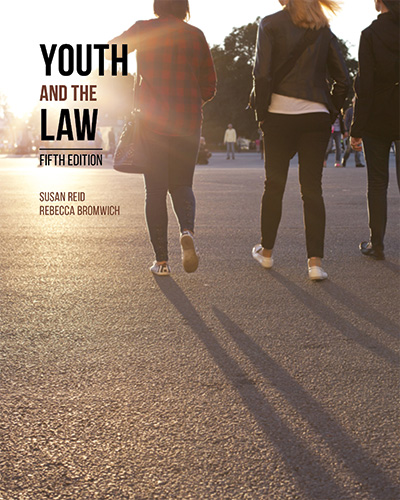 Youth and the law
by
The fifth edition is a comprehensive overview of the ways in which youth interact with criminal law and the criminal justice system in Canada. This will be a moderate revision of the fourth edition, which came out in February 2019. Based on reviewer feedback, a couple of key targeted changes will be made for this edition, while the rest of the revising will be mainly restricted to our standard updating considerations (statistics, legislation, news items, references, etc.). Includes a new chapter on diverse youth."
Youth and the law
by
The fifth edition is a comprehensive overview of the ways in which youth interact with criminal law and the criminal justice system in Canada. This will be a moderate revision of the fourth edition, which came out in February 2019. Based on reviewer feedback, a couple of key targeted changes will be made for this edition, while the rest of the revising will be mainly restricted to our standard updating considerations (statistics, legislation, news items, references, etc.). Includes a new chapter on diverse youth."
 Advanced Introduction to the Law of Treaties
by
The Advanced Introduction to the Law of Treaties discusses the application and interpretation of treaty law, as set out in the 1969 Vienna Convention on the Law of Treaties (VCLT). With a focus on illustrating the living nature of treaty law, Malgosia Fitzmaurice and Agnes Rydberg consider the judicial practice of international courts and tribunals and demonstrate how the law of treaties is an ever-evolving area of public international law. Key Features: Incorporates relevant case law of international courts and tribunals Showcases the VCLT's fundamental importance to states in their daily conduct of international affairs Dissects key aspects of the law of treaties, including consent, reservations and interpretations, as well as amendments and modifications to treaties This book is a vital resource for students and scholars of public international law, as well as practitioners in international law, including practising lawyers, negotiators and legal advisers of foreign offices.
Changing Laws, Changing Lives Behr, Daniela M ; Braunmiller, Julia C
by
Family law has witnessed significant global progress over the past 50 years: Since 1970, 600 million women have gained economic opportunities through family law reforms. In 1970, only 37 economies had equal family laws for men and women, but this number increased to 85 in 2024. Yet, family laws worldwide reinforce inequality, shaping power dynamics within households. In 105 economies, legal frameworks that lay out rights and responsibilities between household members still deny women equal rights in marriage, divorce, inheritance, or decision-making about family and household matters. Rooted in social norms and often dismissed as a private issue, discriminatory family laws limit women’s financial independence and access to jobs and markets, thereby reinforcing systemic disadvantages. The brief underscores that family law is not solely private but a critical public concern with profound implications for women’s labor force participation and global economic growth.
Advanced Introduction to the Law of Treaties
by
The Advanced Introduction to the Law of Treaties discusses the application and interpretation of treaty law, as set out in the 1969 Vienna Convention on the Law of Treaties (VCLT). With a focus on illustrating the living nature of treaty law, Malgosia Fitzmaurice and Agnes Rydberg consider the judicial practice of international courts and tribunals and demonstrate how the law of treaties is an ever-evolving area of public international law. Key Features: Incorporates relevant case law of international courts and tribunals Showcases the VCLT's fundamental importance to states in their daily conduct of international affairs Dissects key aspects of the law of treaties, including consent, reservations and interpretations, as well as amendments and modifications to treaties This book is a vital resource for students and scholars of public international law, as well as practitioners in international law, including practising lawyers, negotiators and legal advisers of foreign offices.
Changing Laws, Changing Lives Behr, Daniela M ; Braunmiller, Julia C
by
Family law has witnessed significant global progress over the past 50 years: Since 1970, 600 million women have gained economic opportunities through family law reforms. In 1970, only 37 economies had equal family laws for men and women, but this number increased to 85 in 2024. Yet, family laws worldwide reinforce inequality, shaping power dynamics within households. In 105 economies, legal frameworks that lay out rights and responsibilities between household members still deny women equal rights in marriage, divorce, inheritance, or decision-making about family and household matters. Rooted in social norms and often dismissed as a private issue, discriminatory family laws limit women’s financial independence and access to jobs and markets, thereby reinforcing systemic disadvantages. The brief underscores that family law is not solely private but a critical public concern with profound implications for women’s labor force participation and global economic growth.

 Completing Humanity
by
After the Second World War, the dissolution of European empires and emergence of 'new states' in Asia, Africa, Oceania, and elsewhere necessitated large-scale structural changes in international legal order. In Completing Humanity, Umut Özsu recounts the history of the struggle to transform international law during the twentieth century's last major wave of decolonization. Commencing in 1960, with the General Assembly's landmark decolonization resolution, and concluding in 1982, with the close of the third UN Conference on the Law of the Sea and the onset of the Latin American debt crisis, the book examines the work of elite international lawyers from newly independent states alongside that of international law specialists from 'First World' and socialist states. A study in modifications to legal theory and doctrine over time, it documents and reassesses post-1945 decolonization from the standpoint of the 'Third World' and the jurists who elaborated and defended its interests.
Completing Humanity
by
After the Second World War, the dissolution of European empires and emergence of 'new states' in Asia, Africa, Oceania, and elsewhere necessitated large-scale structural changes in international legal order. In Completing Humanity, Umut Özsu recounts the history of the struggle to transform international law during the twentieth century's last major wave of decolonization. Commencing in 1960, with the General Assembly's landmark decolonization resolution, and concluding in 1982, with the close of the third UN Conference on the Law of the Sea and the onset of the Latin American debt crisis, the book examines the work of elite international lawyers from newly independent states alongside that of international law specialists from 'First World' and socialist states. A study in modifications to legal theory and doctrine over time, it documents and reassesses post-1945 decolonization from the standpoint of the 'Third World' and the jurists who elaborated and defended its interests.
 Evaluating Campaign Finance Oversight : An Assessment of the Federal Election Commission
by
As campaign finance laws have weakened in the US, so has the Federal Election Commission's ability to enforce them. The agency is underfunded and often has too few commissioners present, and this has led to a partisan imbalance that has favored the Republicans and allowed them to dominate decision-making.
Evaluating Campaign Finance Oversight : An Assessment of the Federal Election Commission
by
As campaign finance laws have weakened in the US, so has the Federal Election Commission's ability to enforce them. The agency is underfunded and often has too few commissioners present, and this has led to a partisan imbalance that has favored the Republicans and allowed them to dominate decision-making.
 The Instant World Report
by
This book proposal focuses on Canada's pioneering role in shaping the international understanding of the right to communicate, particularly through the Canadian Telecommission Studies of 1969. The study argues that the 1971 Instant World report, a landmark document, has been overlooked in the existing literature despite its importance in the history of conceptualizing and implementing this human right. The project aims to fill this gap by exploring the historical context of the report and analyzing its contents, shedding light on themes like privacy and indigenous communication rights. Additionally, the manuscript highlights the unique contribution of Betty Zimmerman, the only female Canadian member of the MacBride Commission in 1977, replacing Marshall McLuhan. Zimmerman's insights become pertinent not only for scholars interested in the New World Information and Communication Order but also for feminist studies, showcasing a leading female figure's role in Canadian communication and cultural policy. The research promises a novel and untold perspective on the history of the right to communicate, addressing gaps in international and Canadian communication, women's studies, and media policy literature.
The Instant World Report
by
This book proposal focuses on Canada's pioneering role in shaping the international understanding of the right to communicate, particularly through the Canadian Telecommission Studies of 1969. The study argues that the 1971 Instant World report, a landmark document, has been overlooked in the existing literature despite its importance in the history of conceptualizing and implementing this human right. The project aims to fill this gap by exploring the historical context of the report and analyzing its contents, shedding light on themes like privacy and indigenous communication rights. Additionally, the manuscript highlights the unique contribution of Betty Zimmerman, the only female Canadian member of the MacBride Commission in 1977, replacing Marshall McLuhan. Zimmerman's insights become pertinent not only for scholars interested in the New World Information and Communication Order but also for feminist studies, showcasing a leading female figure's role in Canadian communication and cultural policy. The research promises a novel and untold perspective on the history of the right to communicate, addressing gaps in international and Canadian communication, women's studies, and media policy literature.
 The Origins of Critical Race Theory : The People and Ideas That Created a Movement.
by
"The Origins of Critical Race Theory humanizes the story of the relationships and experiences that combined to produce one of the most insightful and controversial academic movements in U.S. history"-- Provided by publisher.
Contents
Introduction: Humanizing Critical Race Theory -- Deeply Rooted: Derrick Bell and the Foundations of Critical Race Theory -- Richard Delgado and Jean Stefancic: "People on a Parallel Way" -- Finding Geneva -- Clash of the Titans: The Many Paths toward Critical Race Theory -- Open Season: A Movement Gains a Name -- Conclusion-Story: The Answer from the Beginning.
The Origins of Critical Race Theory : The People and Ideas That Created a Movement.
by
"The Origins of Critical Race Theory humanizes the story of the relationships and experiences that combined to produce one of the most insightful and controversial academic movements in U.S. history"-- Provided by publisher.
Contents
Introduction: Humanizing Critical Race Theory -- Deeply Rooted: Derrick Bell and the Foundations of Critical Race Theory -- Richard Delgado and Jean Stefancic: "People on a Parallel Way" -- Finding Geneva -- Clash of the Titans: The Many Paths toward Critical Race Theory -- Open Season: A Movement Gains a Name -- Conclusion-Story: The Answer from the Beginning.
 Philosophy, Law and Culture of Liberal Democracy and the Authoritarian Challenge
by
Liberal democracy is the great legacy of the Enlightenment; it has reduced world poverty, increased life expectancy, enriched lives by every measure of wellbeing and enlarged our moral compass. Yet, external threats to liberal democracy are posed by totalitarian regimes and their allies seeking to remake the world in their image, and internal pressures arise from opposition to liberal principles from the extremities of the ideological spectrum: radicalism on the left and nativist populism on the right. The defence of liberal democracy requires understanding of its foundational principles, epistemological norms, institutional framework, cultural underpinnings and economic settings. This book argues that the defence of liberal democracy against rising authoritarianism is the great moral imperative of our time. This work combines extensive legal analysis with the history and philosophy of liberal constitutionalism, institutional economics and ethical reasoning. It engages with opposing schools of thought, including radical critical theory and authoritarian ideologies of the right. The book is highly instructive on administrative and constitutional law, the epistemology and ethics of political liberalism and the nature and immediacy of the domestic and external threats to liberal democracy and fundamental rights and freedoms.
Philosophy, Law and Culture of Liberal Democracy and the Authoritarian Challenge
by
Liberal democracy is the great legacy of the Enlightenment; it has reduced world poverty, increased life expectancy, enriched lives by every measure of wellbeing and enlarged our moral compass. Yet, external threats to liberal democracy are posed by totalitarian regimes and their allies seeking to remake the world in their image, and internal pressures arise from opposition to liberal principles from the extremities of the ideological spectrum: radicalism on the left and nativist populism on the right. The defence of liberal democracy requires understanding of its foundational principles, epistemological norms, institutional framework, cultural underpinnings and economic settings. This book argues that the defence of liberal democracy against rising authoritarianism is the great moral imperative of our time. This work combines extensive legal analysis with the history and philosophy of liberal constitutionalism, institutional economics and ethical reasoning. It engages with opposing schools of thought, including radical critical theory and authoritarian ideologies of the right. The book is highly instructive on administrative and constitutional law, the epistemology and ethics of political liberalism and the nature and immediacy of the domestic and external threats to liberal democracy and fundamental rights and freedoms.